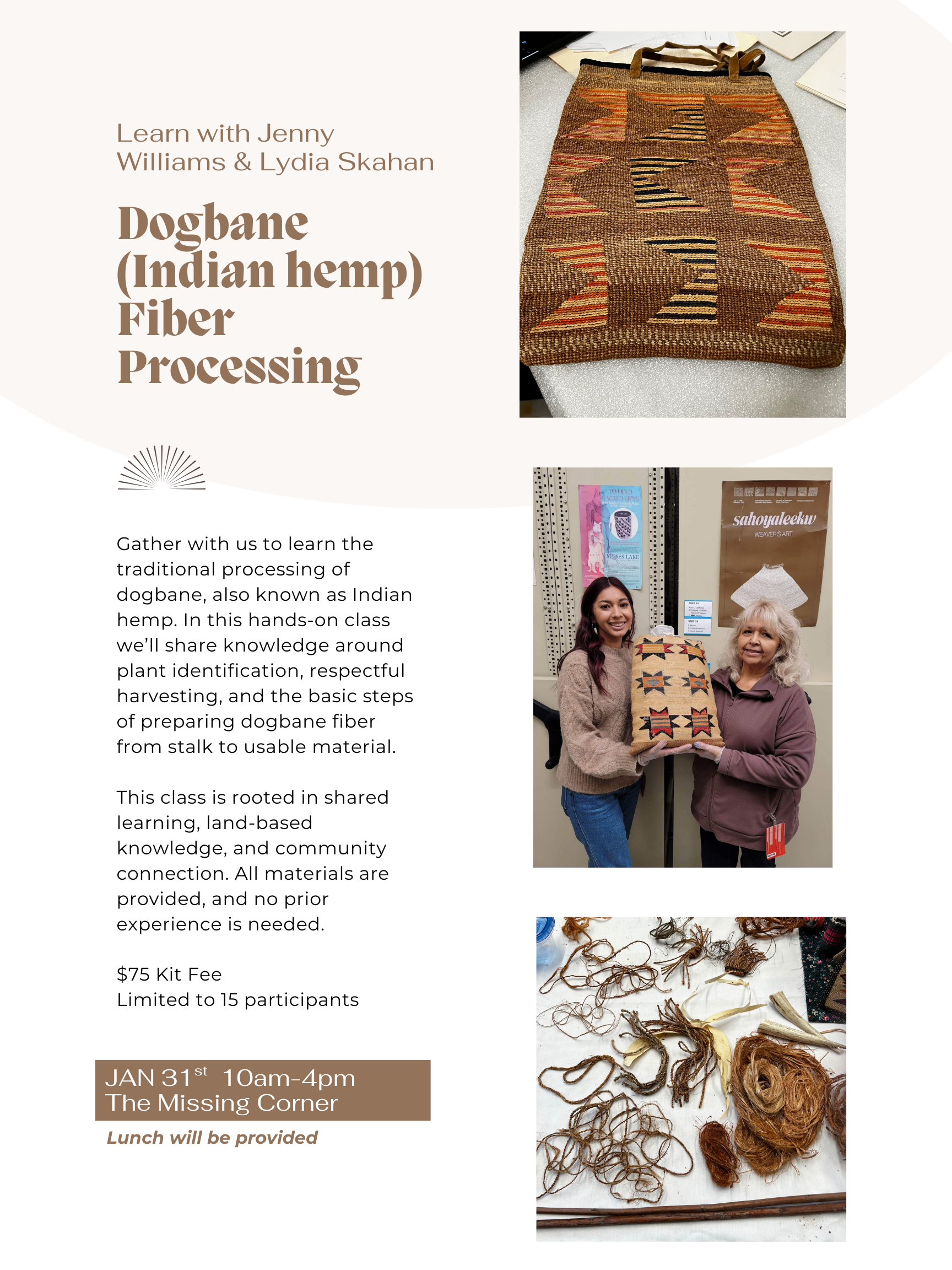
In this hands-on class, we’ll share knowledge around plant identification, respectful harvesting, and the basic steps of preparing dogbane fiber from stalk to usable material.
Participants will practice breaking, scraping, and separating fibers, with an introduction to hand-twisting cordage. This class is rooted in shared learning, land-based knowledge, and community connection. All materials are provided, and no prior experience is needed. Don’t fret about packing a lunch, as one will be provided.
What is dogbane?
Dogbane is a native plant to the area and much of North America. It has been used for thousands of years as a textile plant by Native Americans, in fact, it’s use as a textile can been dated back to as far as 11,000 years ago. Dogbane can be used for many things, such as baskets, nets, rope, bags, hats, and just about anything you could use twine for. Learn what you can do with it through this class!
Logistics & Details
Cost: $75
Note: The minimum covers food, materials, and the Learn Local Series operating costs, not the instructor’s time. Additional contributions above the minimum directly support the facilitator for the gift of their time and expertise.
No one turned away for lack of funds.
Registration:
Space is limited to a max of 15 participants.
A minimum of 10 participants is required to run the class.
No refunds given; however, purchases can be gifted to another.
About the Facilitators
Lydia Skahan is a Nimíipuu (Nez Perce) and Yakama artist, designer, and cultural educator, and an enrolled member of the Confederated Tribes of the Umatilla Indian Reservation. Her work focuses on traditional Plateau arts—including quillwork, cornhusk weaving, and regalia design—blended with modern expression. She teaches workshops and does presentations on Plateau history and culture to schools, universities, and community groups. Through both her artistry and education, Lydia is committed to carrying forward her people’s traditions for future generations.
Jenny Williams: I am Nez Perce/Omaha, raised on the Nez Perce Reservation, and named for my grandmother Jane Red Cloud (Grandma Jenny), a Menominee woman who taught me many traditional skills, from beading and fiber work to food gathering and preparation. I was introduced to cornhusk weaving at the Nez Perce National Historical Park and, with few teachers available, taught myself the foundations of the art—learning designs, forms, and how to gather and prepare natural fibers.
With the support of my family, I have spent decades weaving and gathering materials alongside my children and grandchildren, later studying with master weavers from across the Northwest. I have been a featured weaver at the Northwest Native American Weavers Conference, featured in the Smithsonian’s National Museum of the American Indianmagazine, and have work in the museum’s permanent collection. My work has also been displayed at the Burke Museum’s Bill Holm Center in Seattle.
I weave with cornhusk, pine needles, cedar bark, bear grass, jute, and traditionally processed dogbane (hemp). For more than 30 years, weaving has been both my passion and responsibility, and I am deeply committed to passing this tradition on to future generations.
About Learn Local Series
Learn Local classes are for neighbors by neighbors offerings given from the heart. We partner with you to give the community accessible-to-all experiences that connect and weave us together. You only need to show up and share, we take care of the details at no upfront costs. Doing one of these classes is right for you if you want to gift on your knowledge or skills to the community in an easy, low pressure way. More details about how to do your own here.